


Automotive translation services translate and localize vehicle manuals, technical documentation, marketing, legal and training content for each market, combining machine translation with linguists who specialize in automotive terminology.
Volvo Cars, for example, cut translation time by 60% after replacing spreadsheet-based workflows for 60 to 80 local markets with one centralized translation process on Smartling.
Translation’s role in the automotive industry
Those in the industry understand what’s at stake if a company falls behind on the latest automotive technology. It means slower production, higher costs, and thinner profit margins. Similarly, automotive companies need to stay up-to-date on translation technology to more effectively work with partners and stakeholders worldwide and sell to local markets with different target languages and cultures.
Thanks to modern innovations like Smartling’s machine learning technology, you can get your translations to market much faster than before with 350% higher quality than a traditional single machine engine. Companies can now translate content faster, more accurately, and more affordably than ever.
Translation technologies continue to move quickly, so it’s up to companies to leverage them now so they can scale in the future.
Adam Wooten, associate professor of translation and localization management at Middleburg Institute, provided insight into AI within the automotive sector at Smartling’s recent Global Ready Conference.
"This has always been a fast-evolving industry,” he says. “We have never really been able to sit on our curriculum. [...] Everything needs to be updated much more thoroughly. [...] You can't teach something about quality management or vendor management or computer-assisted translation— anything—without talking about how generated AI has already affected it."
As AI evolves, automotive businesses can benefit from improved efficiency and localize content for more markets to increase their sales.
 The Global Ready Conference explored cutting-edge technologies and the future of translations. (Source)
Watch the Volvo Cars and Middlebury Institute’s insight for automotive companies:
What content needs automotive translations?
What exactly do auto companies need to translate? Think of any materials that your team or brand uses to communicate with others. These materials may relate to everyday business operations and manufacturing communications, along with correspondence with customers, local markets, and investors. There are many types of content that need high-quality translations. Here are some examples:
Marketing materials
When marketing to local audiences, it's critical to communicate on your target audience’s level. Your content shouldn't seem foreign. Instead, it should sound like it’s coming from a local company that understands its customer base.
Culture, history, dialect, and background influence target audiences, and cultural nuances and complexities affect brand perceptions. Something as simple as a color or idiom can affect local buyers’ perception of your brand.
While accurate and relevant marketing is important, consistency is as well. Your brand should communicate the same message and emotions that you conveyed in your source language in other languages, such as Arabic, Spanish, and Dutch.
Types of marketing content you may need to translate include:
- Website content that markets your brand and provides critical information
- Printed materials, like brochures and business cards, for key stakeholders and customers
- Social media content, like product posts or user engagement comments
- Advertisements like Facebook ads that emphasize quality assurance and confidence in the vehicles, products, or services you market
Technical documentation
Customers need many different types of information, such as owner’s manuals, service manuals, technical bulletins, resources, and lists of parts, to safely use your products or engage with your services.
This need is also an essential consideration for your team. Engineers and technical writers already face challenges in communicating complex ideas and processes for car manufacturing and engineering. If you add technical translations—in dozens of languages for different sites or customer bases—to the mix, the process becomes time-consuming and error-prone.
Automotive translation and localization services streamline the translation process to provide greater accuracy and speed. For example, Smartling’s machine translation can quickly translate all your technical documentation. You can also add important terms and phrases to the platform’s translation memory to ensure consistent translations across the board.
Sales, finance, and corporate communications
The automotive industry is highly competitive, so it's imperative that companies clearly communicate their updates, sales health, and financial decisions to their stakeholders.
These stakeholders aren't all from one country or culture, nor do they all speak the same English dialect or come from the same background as you. Because of this, you should ensure that you provide clear content to stakeholders in their native language so everyone is on the same page.
Legal and compliance documents
Companies often deal with warranties, regulatory compliance, and safety standards. Additionally, customers need to sign legal forms, contracts, and other essential documents during the buying process.
Legal document translations are important for accuracy, compliance, and ethical reasons. When translating these documents, you’ll want to ensure that readers understand your intended message and expectations with absolute clarity.
Training resources
Quality and efficiency matter in the automotive industry since they affect how buyers and stakeholders perceive your brand. That's why it's essential to provide your employees with consistent training, no matter where they live.
For example, both U.S. and Japanese teams should clearly understand your company's processes, protocols, and ultimate vision. Consistent translations break down language barriers to help employees understand your company's goals, culture, and methodologies.
|
Content type |
Accuracy risk |
Recommended approach |
|---|---|---|
|
Owner's and service manuals, safety warnings |
Very high: errors can cause injury or liability |
Specialist human translation or AI translation with full expert review; locked glossary of part names |
|
Technical bulletins and parts lists |
High: part names and specifications must match exactly |
Translation memory plus terminology database; machine translation with post-editing |
|
Legal, warranty and compliance documents |
Very high: must stay enforceable in each market |
Certified or legal-specialist translators |
|
Marketing, website and ads |
Medium: brand and cultural fit matter more than literal accuracy |
Transcreation by native-speaking marketing linguists |
|
Dealer and employee training |
Medium |
AI translation with human review; reuse translation memory across updates |
|
Investor and corporate communications |
High: financial figures and disclosures |
Financial-specialist translators with review |
How did Volvo Cars cut translation time by 60%?
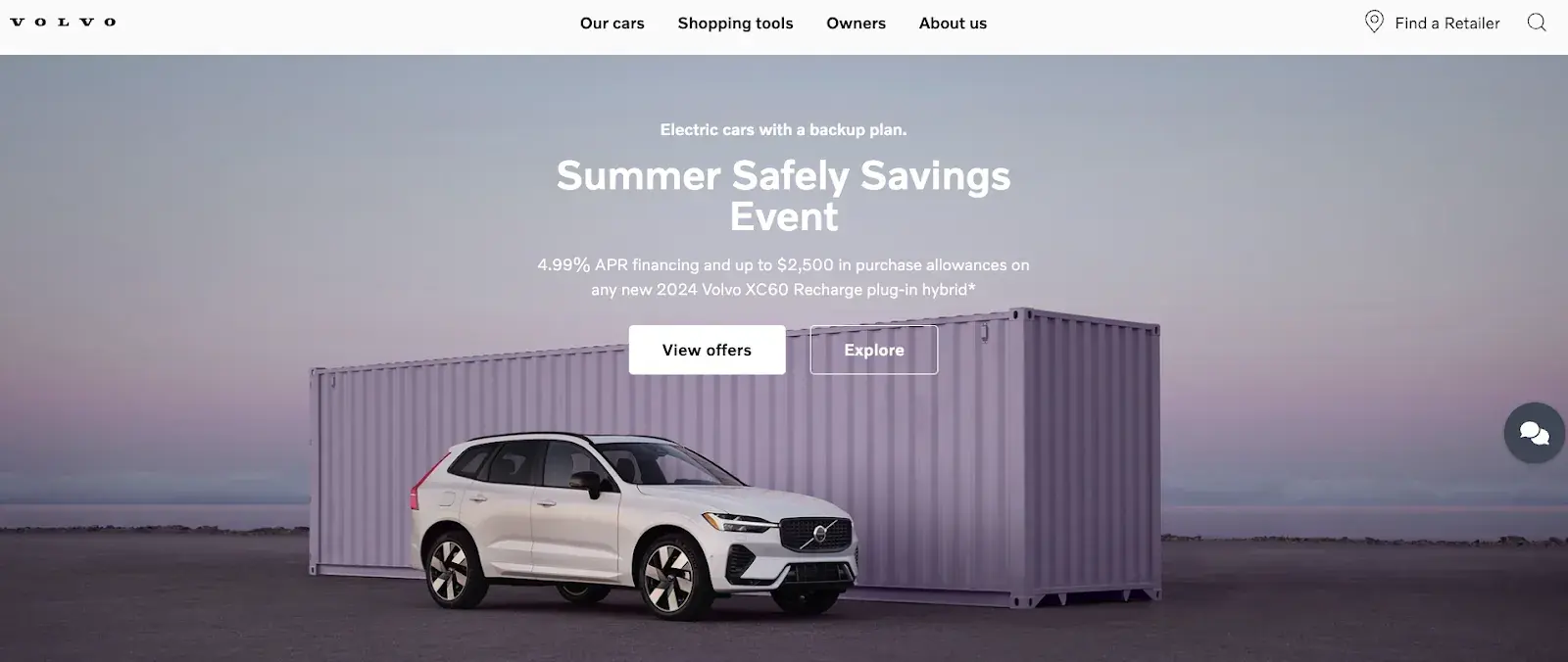
Volvo Cars' home page (Source)
Volvo Cars cut translation time by 60% by replacing spreadsheet-based workflows for 60 to 80 local markets with one centralized Smartling process. Marcus Ivarsson, head of localization management at Volvo Cars, described the old Excel-based approach as a "nightmare" at that scale.
After centralizing translation and training translation engines on approved translation memory, Volvo's central team now runs global rollouts in one workflow for every market and language.
Marcus Ivarsson, head of localization management at Volvo Cars, also talks about the importance of translation memory.
“[We] utilize all of our translation memories, where we have translations approved by our stakeholders, our markets—and that’s very subjective,” he says. “What’s a good translation? [...] We thought, ‘Let’s train translation engines on these [approved translation] assets.’ Once we did that, [...] we saw that the time to market is off the charts.”
Ivarsson remembers the days when his team would start with Excel sheets that contained content in the source language and transform them into translated content. Over time and with global growth, this method proved to be inefficient and error-prone.
Ivarsson described the process as a "nightmare" when dealing with 60–80 local markets. Because of this, he and his team decided to undergo a digital transformation to produce more efficient and accurate translations at scale.
He and his team chose Smartling to create affordable, efficient, and accurate translations.
“With the help of Smartling, we were able to centralize the way we were working with translations,” Ivarsson says. “We had one way of doing translations for all markets, all languages. [...] But now, we are doing it the correct way. We have a central team working with global rollouts, with the translations, [and with] all of the aspects in the content library. [...] [We saved] 60% of translation time. [...] We’re slashing off a lot of [expenses].”
Adopting tools and language services to make translation projects faster and more accurate can help companies connect more effectively with stakeholders and global markets.
How to ensure precision and consistency across automotive translation workflows
To maintain speed, affordability, and accuracy in translations, automotive companies should adopt the following tools and services:
- AI tools to translate content: Machine learning technologies like Smartling translate billions of pages of content per minute to create fast, affordable translations of user manuals, automotive design documents, and more.
- Management software to process translations: To ensure high quality and organization, teams should use a platform that helps them verify content and collaborate more effectively, such as Smartling’s translation management system.
- A local team to localize content: Expert linguists based in your local market know best how global audiences will perceive your content. For example, Smartling’s 100% native-speaking translators can identify nuances and complexities that machines cannot. These experts can also gauge emerging trends and cultural shifts that may affect content perception and can use transcreation to add any necessary content to fill in the gaps.
All of these tools and services comprise an AI-powered human approach that provides professional automotive translations at scale.
How do AI and human translators work together on automotive content?
Machine translation produces a fast first draft, and native-speaking automotive linguists then revise it for accuracy, terminology and cultural nuance. Over time, each approved translation is saved to translation memory, so the AI reuses the company's preferred terms in every market and the amount of human editing goes down.
Not only can humans and machines work together for more effective translations, but they can also improve over time to provide a more consistent, on-brand voice. For example, humans can inform AI by updating your translation memory with specific phrases and terms. The next time AI translates one of these source language phrases, it will then know your preferred translation for that local market or culture.
How Smartling provides accurate automotive translations
 Smartling’s translation platform provides the tools and linguists you need for top-notch automotive translations. (Source)
Smartling is an all-in-one solution for automotive translation and localization. Its LanguageAI technology helps you translate billions of words in seconds.
Tools like Smartling’s Neural Machine Translation Hub produce faster content translations than traditional methods. Your teams can then work within the translation management system to manage their workflows and revise translated content. That’s where localization comes in—Smartling's expert translators can revise translations for each local market’s context and nuances. You can increase your sales in local markets with the highest-quality translation services and technologies.
Discover how Smartling can improve your team’s collaboration and communication with stakeholders with fast, accurate translations—book a demo today.
